
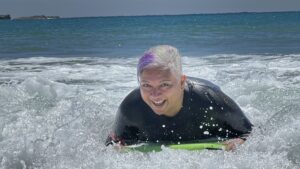
Just like that, another year has flown by. I think it’s called getting older. This haiku kinda captures it:
I am super tired
Where did all of my money go
My back hurts
Welcome back to my occasional newsletter. It feels to me like the Year of the Snake has not been an easy one for many. So, I am looking forward to meeting the Year of the Horse.
When I think about what might be my life’s purpose (other than painting, cooking, reading, surfing, and gardening, being a good friend/partner/family and community member), I think I would describe it as trying to make meaningful change happen for a kinder more caring world. It feels that this year has involved a lot of that in working with people and arts, community, and health organisations to find ways to ensure that their staff and clients feel safe, supported, and nurtured. In a harried and technocratic world, we still need to take care of people, especially when there is so much loss and suffering.
Many of the challenges facing my home field of healthcare are resonant in other contexts, including the arts. Transformative opportunities come from an awareness of who is and is not accessing services, and how to engage with groups that are ostensibly “hard to reach”. As organisations grapple with their responsibilities to Indigenous sovereignties, changing demographics, and the demand that people’s uniqueness and identities are responded to with care and respect, these issues become more central to creating spaces where staff can learn and grow. It has been an enormous privilege to be trusted with activating the knowledge and skills organisations already possess, to help them prepare for a rapidly changing environment.
Youth
Youth workers practice relationally with young people and work to help them thrive and participate in their communities. In January, I worked with Robert Stevens, the Coordinator of Youth & Middle Years at Yarra City Council, to develop a cultural safety workshop. Yarra Youth’s programs include leisure, arts, music, drug and alcohol support, youth justice, employment pathways, housing, and youth empowerment/leadership. In April, we had a follow up workshop on “Working with Challenging Behaviors: Navigating Boundaries and Responses”. Youth workers, like other professionals who work with people in unequal relationships, need clear boundaries to ensure the safety of young people in youth work. I am really enjoying the dynamic team, and they do awesome work with young people. I am amazed at just how broad the work is and how the scope of youth work has changed over time, going from being focused on “welfare” and control or risk-management, into youth work that centres young people and their needs and respects young people’s diverse social contexts, and increasingly emancipatory and anti-oppressive ways as advocates for young people individually and collectively. We are taking these conversations further in the new year, and it is making me feel young again!
Chunky Move
Equity Action Plans (EAP) are a way for organisations to formalise their commitment to inclusion across gender, sexuality, disability, and cultural diversity, including through targets, data collection, and accountability measures. This year, I worked again with Chunky Move, one of the most influential dance companies in Australia, to help flesh out their EAP for their next phase. I loved working with Executive Director Kristy Ayre, Artistic Director Antony Hamilton, and their staff. I have really appreciated working with arts organisations like Chunky Move to consider how concepts from a healthcare background such as Cultural Safety can influence their operations and relationship to audiences.
SETsCOP
Supporting people in care roles to care for themselves is critical, especially in the absence of institutional support. Back in Aotearoa New Zealand in 1995, I used to offer workshops to Plunket Nurses (Maternal and Child Health Nurses) for the intense and complex work they were doing at the Family Centre in Meadowbank. This February, I delivered a workshop for the Settlement Engagement and Transition Support (SETS) program Community of Practice (CoP). The workshop covered polyvagal theory, self-regulation, and co-regulation, and I talked about various practical strategies that settlement workers can use to navigate their often stressful work, including sound, breath, progressive muscle relaxation, visualisation, cold water, yoga, walking, and ear massage (give it a try!).
Darebin City Council Diversity & Inclusion Action Plan
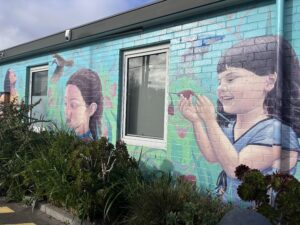
Being a welcoming city is a priority for Darebin City Council, a sector leader in welcoming and inclusion practice, programs, and initiatives. They were the first local council in Australia to be awarded the level of “Excelling” in the Welcoming Cities accreditation scheme. Back in May, I worked with my friends at Paper Giant, a strategic design consultancy, to help Darebin build on this work toward their Cultural Diversity and Inclusion Plan. As community engagement lead, I consulted with passionate and engaged community members, Council employees, and elected representatives about Darebin’s policies, programs, and services. The results will support the rights, inclusion, and well-being of people and communities from Culturally and Linguistically Diverse backgrounds and migrant communities living, working, studying, or accessing services and spaces in Darebin. It was a pleasure to work with Paper Giant CEO Chris Marmo and Shabaz Fattah, Multicultural and Diversity Officer at Darebin, to embed changes that are visible and meaningful to the constituents.
Ripple: Disability and Culturally Diverse Internship Program
People with disabilities experience barriers to engagement in cultural life both as audiences and as creators. There are also specific barriers to opportunity and career progression for people with disability who are from diverse cultural backgrounds. Professor Grace McQuilten and her colleagues published research which showed that there is a need for greater transparency and reporting of disability and cultural diversity representation in staffing, including leadership and board roles, to promote accountability and drive cultural change in the arts. They also recommended that there are funding incentives to support diverse leadership, including higher pay to compensate for the additional workload carried by workers from First Nations, disability, and culturally diverse backgrounds. I was glad to contribute to this work by being a presenter in the Ripple: Disability and Culturally Diverse Internship Program led by Accessible Arts in partnership with Diversity Arts Australia. It offers eight paid internships for people with disability or who are d/Deaf and who identify as culturally and linguistically diverse. The programme offers specialised industry training and part-time work experience at leading arts and cultural organisations, including the Art Gallery of New South Wales, Utp, APRA AMCOS, 4A Centre for Contemporary Asian Art, Campbelltown Arts Centre, Powerhouse Museum, and National Portrait Gallery, over 14-weeks. This year, I delivered two cultural safety workshops for the 2025 cohort, exploring various frameworks including Intersectionality, Critical racism/ableism consciousness, Disability Critical Theory (DisCrit), and Cultural Safety. j
Women’s Health Victoria
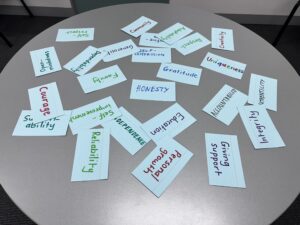
Reproductive justice and bodily autonomy are under threat locally and globally. Women’s Health Victoria is a leading voice in women’s health: a statewide, feminist, not-for-profit organization committed to gender equity in health who work with government, the health sector, and the community to create better health outcomes for women (cis and trans inclusive) and gender diverse people. I have worked with this fantastic organisation for many years. In May, I worked with powerhouse duo CEO Sally Hasler and equity champion and manager of 1800 My Options, Carolyn Mogharbel to bring staff together to talk about how to create a robust culture of lived values to support their work driving gender-transformative health systems in Victoria. We explored how WHV fits into the women’s health ecosystem, how to strike a balance between personal and professional values, balancing being an advocate for communities, being a critical friend to the government, while also ensuring resilience and sustainability within the organisation.
Creative practice in place
In June-July, I taught the subject Creative Practice in Place: Working on Unceded Lands at RMIT University for the third year with photographer and artist Dr Jody Haines, a Palawa/Tommeginne artist based in Naarm/Melbourne. One of the sessions that’s really important to me is how we think through the relationship between ‘multiculturalism’ and First Nations custodianship. I invite the students to explore who benefits from arrangements that insist upon the integration of ‘ideal’ migrants into an implicitly White mainstream. We dive deep into diasporic histories and discourses about communities including Greeks, Italians and South Asians, and discuss concepts like allyship, solidarity, and privilege. In a session on Cultural Safety we explore Eurocentrism, legitimacy, representation, voice, who is included, excluded, represented, misrepresented, appropriated, or tokenised, in galleries, museums, and art institutions. We explore reflexivity and positionality, and sites for non-Indigenous people’s work drawing on Clare Land’s marvellous book Decolonising Solidarity. We concluded with an exhibition that was beautifully curated by Jody and attended by many RMIT staff and students, and proud friends and family members.
Our Watch
I have long had an interest in the role of mainstream media in (mis)representing marginalised communities, and even started my own e-mail listserv and online journal back in the day because I was concerned about how ethnic communities were represented. The news media play a critical role in shaping public opinion, and how they report on violence against women plays a part in reducing and eliminating violence. Those working in the media also have the power to influence how Aboriginal and Torres Strait Islander communities are perceived and understood. So I was pleased to be invited in July to facilitate a kick-off meeting for a partnership between two of my favorite organisations, Our Watch and Indigenous X. Our Watch leads primary prevention of violence against women in Australia, and developed a comprehensive and world-leading national strategic approach to primary prevention in their ‘Change the Story’ report. Indigenous X is an Indigenous owned and operated, independent media, consultancy, and training organisation. They are collaborating to develop a training package for journalists on preventing violence against Aboriginal and Torres Strait Islander women, funded by the Commonwealth government under the Second National Action Plan to End Violence Against Women and Their Children. The training packages that will be developed take a co-designed, decolonising approach drawing from the recommendations of a Yarning circle held in 2024 with Aboriginal and Torres Strait Islander journalists, media professionals, academics, and the violence against women sector.
NIDA
Care is ethical and practical. In July Dr Görkem Acaroğlu a Turkish Australian interdisciplinary artist and academic, invited me to run a workshop on “Care” for the year-long MFA (Cultural Leadership) second year subject, Cultural Transformation and Sustainability, co-taught with Course Leader Amanda McDonald Crowley at The National Institute of Dramatic Art (NIDA) in Sydney. We covered a lot of ground in the workshop including the role of care work care work in sustaining capitalism (producing and maintaining workers); gender, class and racial critiques of care; “care washing” and institutional co-optation; sentimentalisation and depoliticisation; class and labor exploitation; the limits of liberal individualism, threadbare care systems; mutual aid and collective care, and Cultural Safety (as in how the recipient of care, experiences care). I enjoyed talking about the Nurses and Midwives Art Exchange from my Vice Chancellor Fellowship days at RMIT.
Norway
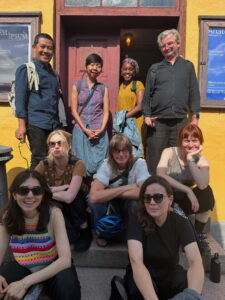
From 12 August – 11 September 2025 I attended a PRAKSIS residency co-developed with the Asia Pacific Artistic Research Network (APARN). PRAKSIS is a transnational platform for art, research and learning based in Oslo. This residency: Climate / Coloniality invited artists to consider sustainability in the context of critical approaches to colonial knowledge, and explore new modes of community-engaged practice on a planet under threat. We stayed in accommodation in Holmenkollen in the Vestre Aker borough of Oslo, Norway. It is 500 metres (1,600 ft) above sea level and known for its international skiing competitions. It was a steep ten-minute walk to the metro and a forty-minute train ride to the city and then a short stroll to Praksis. In keeping with its commitment to peer-to-peer dialogue we had a wonderful few weeks of talking as a big group and as smaller groups exploring climate and coloniality. Keep an eye out for podcast conversations and publications to come.
PhD supervision
I have the privilege of co-supervising two PhD students. At the University of Melbourne, with Dr Sarah Austin, I am co-supervising theatre-maker Isabella Vadiveloo who is looking at how artist identity informs directing text-based theatre using cultural safety. Bella is a theatre director and intimacy coordinator in Melbourne, Naarm, who identifies as mixed race white and Tamil Sri Lankan. They are completing their PhD with 50% dissertation and a 50% practice outcome staging a theatrical work using their research. At Western Sydney University, together with Prof Kerry Robinson (Sociology) and A/Prof Lucy Nicholas (Gender and Sexuality), I am co-supervising Samantha Petric’s PhD, examining how the Australian nursing profession is experienced as culturally safe/unsafe for trans and gender diverse (TGD) nurses, and if the framework of cultural safety is adequate for supporting the workplace safety and inclusion needs of TGD nurses.
Global Critical Midwifery Summit
Critical Midwifery Studies (CMS) is a growing global field committed to decolonial, justice-oriented, and critically engaged approaches to midwifery education, practice, and scholarship. My friend, midwife, educator, and former podcast guest on Birthing and Justice Annabel Fakhri (Farry) is undertaking a PhD examining how this concept works in the context of Aotearoa. She convened a beautiful roopu (group) of amazing kahu pōkai (midwives) in November. I cried within 2 minutes of our hui (meeting) when Waikato midwife Tamara Karu opened the summit for us. At a time of such sadness and suffering in the world, this summit was very joy-inducing.
MAKE SOME SPACE
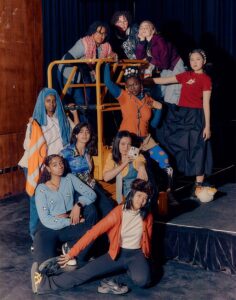
In November, I facilitated a workshop at Footscray Community Arts (FCA) as part of a youth-led arts event called MAKE SOME SPACE, organised by Dr Sarah Austin and Samatha Butterworth. Sam is a senior producer at Performing Lines, which produces provocative contemporary performance by Australian independent artists. Sarah is a performance maker with specific expertise in creating work with, for and by children and young people, as well as being the coordinator of the Bachelor of Fine Arts (Theatre) at the The Victorian College of the Arts (VCA). MAKE SOME SPACE brings together 10 talented people aged between 16-25 and offers professional development workshops on collaborative practice and creative producing as they work toward creating an event at FCA on 13th December, based on the model of a Town Hall Meeting. I loved meeting and talking with Tarenya Joshi, Sabrina Lee, Casper Hluschko, Luqman, Mabruka O, Edith-Peace, Sannie, Elisha Lule, Enhui and Lars Carey about cultural safety, equity and inclusion within art making and collaboration. We also explored ideas of care in creative encounters. I am so excited about their Town Hall event and can’t wait to see how their art futures evolve.
End of the year
My partner Danny starts teaching before the March academic semester begins and returns to work early in the new year. We plan to head off on our annual camping trip in Yuin country, off-road and away from mobile reception. It’s our annual reset before a flurry of family visits in NSW, QLD, and NZ. I hope that you have similar plans to rest up and relax over the festive season.I hope to work with you on projects in the new year – reach out any time if you have something we could do together.
Copyright (C) 2025 Ruth De Souza. All rights reserved.